
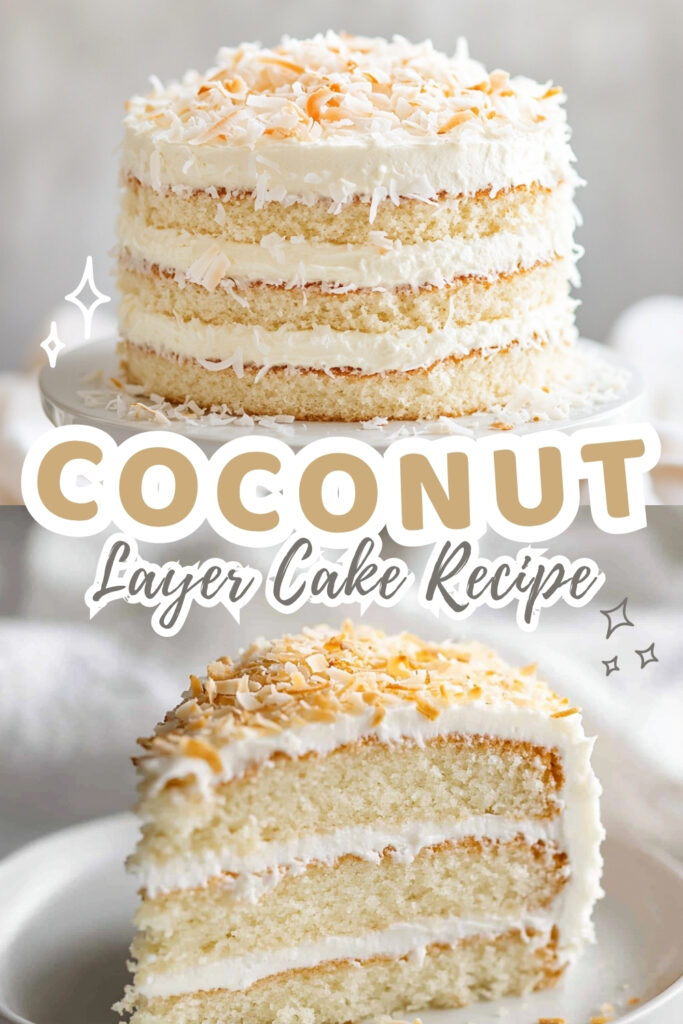
A soft, fluffy coconut cake with tangy cream cheese frosting and toasted coconut. A reliable, bakery-style layer cake with balanced flavor and texture.
This classic coconut cake is built for consistency. It delivers soft, plush layers with a clean vanilla base, finished with a lightly tangy frosting and a crisp toasted coconut coating.
I approach this cake like a controlled formula. Every ingredient has a role, and every step is designed to create a stable, tender crumb without heaviness or greasiness.
The result is not overly coconut-forward. Instead, it’s a balanced cake where coconut supports the texture and finish, rather than dominating the flavor.
If you want a layer cake that slices cleanly, holds its structure, and still feels soft on the fork, this is the one I rely on.
Ingredients Needed for the Recipe
- All-purpose flour – provides the structural framework and determines the final crumb density.
- Granulated sugar – sweetens while also tenderizing by limiting gluten development.
- Baking powder – creates lift and ensures an even, consistent rise across all layers.
- Kosher salt – sharpens flavor and balances the sweetness in both cake and frosting.
- Unsalted butter – contributes flavor and helps create a fine, tender crumb through fat distribution.
- Sour cream – adds moisture and richness while creating a soft, slightly tangy interior.
- Full-fat coconut milk – introduces subtle coconut flavor and additional fat for tenderness.
- Neutral oil – improves moisture retention and keeps the cake soft even after refrigeration.
- Eggs – provide structure and binding while contributing to overall stability.
- Vanilla extract – anchors the flavor profile and enhances the perception of sweetness.
- Cream cheese – forms the base of the frosting, adding tang and body.
- Butter (for frosting) – stabilizes the frosting and improves spreadability.
- Powdered sugar – thickens the frosting and provides structure for clean layering.
- Additional sour cream (frosting) – increases tang and softens the frosting texture.
- Coconut milk (frosting) – lightly reinforces coconut flavor without overpowering.
- Sweetened shredded coconut – creates the outer coating and provides texture contrast.
How to make Classic Coconut Cake?
Step 1 – Prepare the pans and oven
Preheat the oven to 350 F and prepare three 8-inch pans with parchment and grease. Proper pan prep ensures even release and prevents tearing in delicate layers.
Make sure your ingredients are at room temperature before starting. Cold ingredients can cause uneven mixing and a broken batter.
Step 2 – Combine dry ingredients
In a stand mixer, mix the flour, sugar, baking powder, and salt. This step ensures even distribution of leavening before fat is introduced.
Take a moment to visually check for clumps. A uniform dry mix leads to a more consistent crumb later.
Step 3 – Reverse creaming with butter
Add softened butter one tablespoon at a time with the mixer on low speed. Continue mixing until the texture becomes sandy with small butter pieces.
This method coats the flour in fat, limiting gluten formation and creating a fine, velvety crumb structure.
Step 4 – Mix the wet ingredients
In a separate bowl, whisk together sour cream, coconut milk, oil, eggs, and vanilla until smooth. The mixture should be cohesive and slightly thick.
If the coconut milk is separated, warm it gently before mixing. A smooth liquid base prevents uneven batter texture.
Step 5 – Combine wet and dry
Slowly stream the wet mixture into the dry ingredients while mixing. Once combined, increase speed to medium and mix for about one minute.
The batter should look silky and slightly thick. Avoid overmixing, as it can tighten the crumb.
Step 6 – Divide and bake
Divide the batter evenly between the pans, roughly 565 grams per pan. Even distribution ensures consistent baking across layers.
Bake for about 30 minutes until the edges are lightly golden and the center springs back when touched.
Step 7 – Toast the coconut
Spread shredded coconut on a baking sheet and bake at 350 F for about 20 minutes, stirring every 5 minutes.
The goal is an even golden color. Watch closely, as coconut can burn quickly toward the end.
Step 8 – Make the frosting
Beat cream cheese and butter until smooth. Add powdered sugar gradually, then mix in sour cream, coconut milk, vanilla, and salt.
Beat until pale and fluffy. The texture should be spreadable but stable enough to hold layers.
Step 9 – Assemble the cake
Layer the cooled cakes with frosting between each layer. Apply a thin coat first, then finish with a full layer of frosting.
Press toasted coconut onto the exterior while the frosting is soft. Work gently to avoid pulling crumbs into the coating.
Why This Recipe Works
This cake is built on balance rather than intensity. The ratio of fat to flour is carefully controlled to create softness without collapse.
Using both butter and oil gives the best of both worlds. Butter provides flavor, while oil maintains moisture over time, especially after refrigeration.
The reverse creaming method is key to the texture. By coating flour in fat early, gluten development is limited, resulting in a tighter, more delicate crumb.
Sour cream plays a central role. It adds moisture and acidity, which softens the structure while supporting the leavening process.
The frosting is intentionally tangy. The higher proportion of cream cheese keeps sweetness in check and prevents the cake from feeling heavy.
How I Tested and Refined This Recipe
I started with a traditional vanilla cake base and experimented with adding coconut milk. The first version was too rich and slightly greasy due to excess fat.
Next, I adjusted the ratios by reducing eggs and increasing sour cream. This created a softer crumb with less bounce and more tenderness.
I also tested different fat combinations. Using only butter made the cake firm when chilled, while adding oil improved softness across multiple days.
The coconut flavor took several rounds to refine. Adding more coconut directly into the batter made the texture uneven, so I shifted the focus to the exterior.
For the frosting, I reduced butter and increased cream cheese. Early versions were too sweet and lacked structure, but this ratio created a stable, balanced finish.
Common Mistakes and How to Avoid Them
- Overmixing the batter – leads to a dense, tight crumb instead of a soft interior.
- Using cold ingredients – causes the batter to break and results in uneven texture.
- Skipping proper butter incorporation – prevents correct reverse creaming and affects structure.
- Uneven batter distribution – leads to layers baking at different rates.
- Overbaking – dries out the cake and reduces the tender quality.
- Burning the coconut – happens quickly if not stirred frequently during toasting.
- Frosting warm layers – causes sliding and structural instability.
Make-Ahead, Storage, and Freezing Guidance
The cake layers can be baked ahead and frozen for up to two weeks. Wrap them tightly to prevent moisture loss and freezer burn.
Toasted coconut can be stored at room temperature in an airtight container for about a week without losing texture.
Once assembled, the cake should be refrigerated due to the cream cheese frosting. It will stay fresh for up to 4 days.
The texture firms up slightly in the fridge, but softens again at room temperature. Let slices sit out for 20 minutes before serving.
Individual slices can be frozen and thawed overnight in the refrigerator. The crumb remains stable and moist after thawing.
Tips
- Weigh your batter for even layers instead of estimating.
- Use a serrated knife to level layers for clean stacking.
- Chill layers briefly before frosting to reduce crumbs.
- Toast coconut in batches if your oven has hot spots.
- Adjust powdered sugar in frosting based on humidity.
- Use a turntable for smoother frosting application.
- Press coconut gently to avoid damaging the frosting layer.
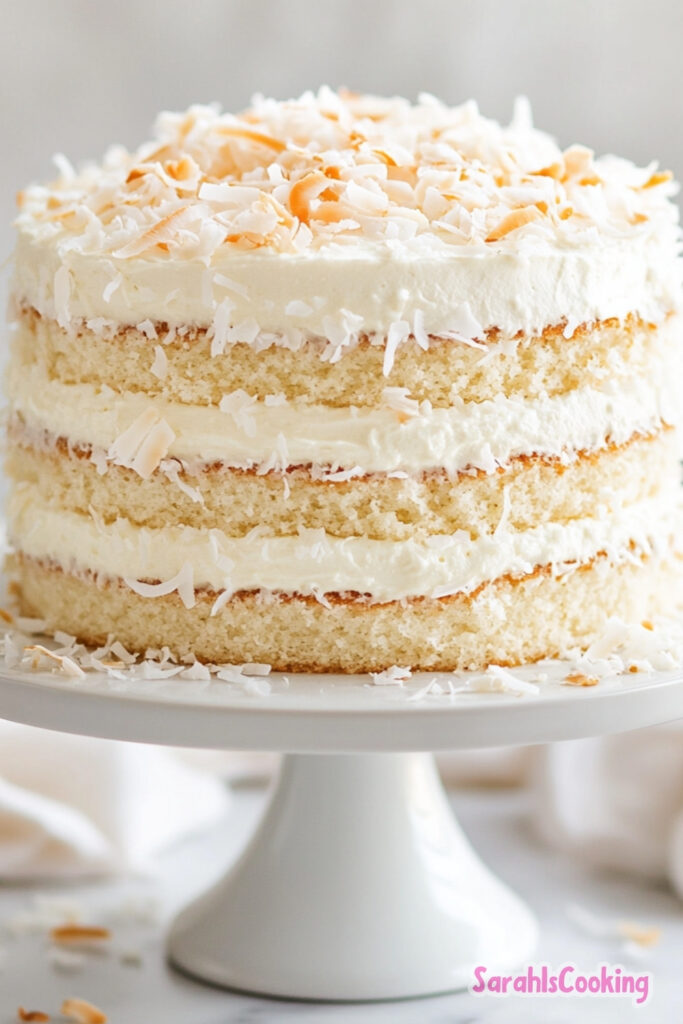

Classic Coconut Layer Cake Recipe
Description
This soft and fluffy coconut cake features tender layers of plush sour cream vanilla cake, a tangy cream cheese frosting and lots of toasted coconut to finish. If you're looking for a very subtle coconut flavor but a crunchy toasted coconut exterior, you'll love this cake! Perfect for celebrations, birthdays, or any special occasion where a dreamy, elegant dessert is called for.
ingredients
For the Cake
For the Cream Cheese Frosting
For the Topping
Instructions
Make the Cake Layers
Preheat & Prep Pans
Preheat oven to 350°F (175°C). Grease and line three 8-inch round cake pans with parchment paper.Parchment ensures easy release of tender layersCombine Dry Ingredients
In the bowl of a stand mixer fitted with paddle attachment, combine flour, sugar, baking powder, and kosher salt.Reverse Creaming Method
With mixer on low speed, add softened butter 1 tablespoon at a time until fully incorporated. Continue mixing for 3 full minutes until mixture looks sandy with tiny butter chunks—this coats flour molecules for a velvety, tender crumb.Do not skip the 3-minute mix time!Prepare Wet Ingredients
In a separate bowl, whisk together sour cream, coconut milk, neutral oil, eggs, and vanilla extract until smooth. If coconut milk is chunky, microwave 30 seconds to smooth.All ingredients should be at room temperature for best emulsionCombine & Mix Batter
Slowly stream the wet mixture into the dry ingredients. Once incorporated, mix on medium speed for 1 minute until you have a smooth, silky batter.Do not overmixBake Layers
Divide batter equally among prepared pans (~565g per layer). Bake 30 minutes or until edges are golden, cake springs back when lightly pressed, and a tester comes out clean.Rotate pans halfway through for even bakingCool Completely
Cool cakes in pans 10 minutes, then turn out onto wire racks to cool completely before frosting.Warm cake will melt frosting
Toast the Coconut
Toast Coconut
While oven is still at 350°F (175°C), spread shredded coconut in an even layer on a baking sheet. Bake 18-20 minutes, stirring every 5 minutes, until light golden brown. Cool completely.Watch closely—coconut burns quickly!
Make the Frosting & Assemble
Beat Cream Cheese & Butter
In stand mixer bowl, beat softened cream cheese and butter on low speed until smooth and combined, about 1 minute.Softened (not melted) ingredients prevent lumpsAdd Powdered Sugar
Gradually add 3 cups powdered sugar, ½ cup at a time, on low speed until incorporated.Scrape bowl as neededFinish Frosting
Add sour cream, coconut milk, vanilla, and salt. Beat on medium speed 3 minutes until pale, fluffy, and smooth. If too thin, add remaining ½-1 cup powdered sugar.Frosting should hold soft peaksFrost & Decorate
Place first cake layer on serving plate. Spread with frosting. Repeat with second layer. Top with third layer. Apply crumb coat, chill 15 minutes, then apply final coat. Press cooled toasted coconut onto sides and top of cake.Use hands or offset spatula; this will be messy but worth it!
Nutrition Facts
Servings 12
Serving Size 1 slice (1/12 of cake)
- Amount Per Serving
- Calories 890kcal
- % Daily Value *
- Total Fat 45gg70%
- Saturated Fat 27gg135%
- Trans Fat 0gg
- Cholesterol 115mgmg39%
- Sodium 280mgmg12%
- Potassium 145mgmg5%
- Total Carbohydrate 112gg38%
- Dietary Fiber 2gg8%
- Sugars 78gg
- Protein 9gg18%
- Calcium 8% mg
- Iron 6% mg
* Percent Daily Values are based on a 2,000 calorie diet. Your daily value may be higher or lower depending on your calorie needs.
Note
- More coconut flavor? Swap half or all of the vanilla extract for pure coconut extract in the cake batter.
- Room temperature ingredients: Bring eggs, sour cream, butter, and coconut milk to room temperature 1-2 hours ahead for best emulsion and texture.
- Make ahead: Bake and freeze cake layers up to 2 weeks ahead; toast coconut up to 1 week ahead; make frosting day-of for best texture.
- Storage: Store leftover cake covered in refrigerator up to 4 days. Bring to room temperature 30 minutes before serving for best flavor and texture.
- Smaller cake option: Reduce all ingredients by ⅓ to make a single 8-inch layer cake.